

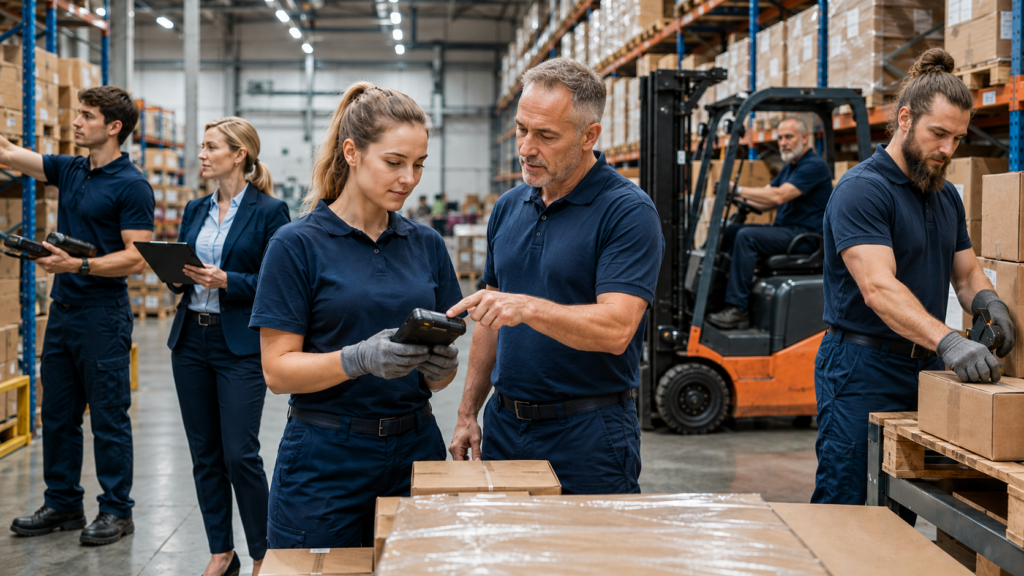
Why it pays for companies to retrain their own people instead of competing long-term for the same candidates on the external market
| Companies in Slovakia are increasingly facing the problem that there are not enough suitable candidates on the external market for critical positions. One of the most practical solutions therefore does not have to be outbidding competitors for people, but systematic work with existing employees. Retraining a production operator into a warehouse worker with forklift certification is a good example of a solution that can be faster, more stable and more economically reasonable. |
The Slovak labour market is pushing companies to work more with internal potential
The Slovak labour market is in a state where external recruitment alone is no longer a sufficient answer to the needs of manufacturing, logistics and industrial companies. According to the Ministry of Labour, Social Affairs and Family of the Slovak Republic, in March 2026 the share of available jobseekers of productive age was 4.03%. At the same time, 123,983 job vacancies were registered, which the ministry described as the historically highest number of job vacancies in Slovakia. [1]
At first glance, it may seem that with more than 145,000 available jobseekers, companies should have plenty to choose from. Practice, however, shows something different: the availability of candidates does not automatically mean the availability of people with the required qualifications, work habits, medical fitness, reliability and willingness to work in a specific operation.
The Statistical Office of the Slovak Republic also states that in 2025, the long-term unemployed accounted for 63% of the structure of unemployed people. This confirms that part of the workforce is formally available on the market, but not always immediately usable for the needs of production and logistics.[2]
| 4.03% share of available jobseekers in March 2026 Share of available jobseekers of productive age | 123,983 job vacancies Registered in March 2026 | 63% long-term unemployed Share in the structure of unemployed people in 2025 |
For companies, this leads to a simple conclusion: if they want to keep production, logistics and dispatch running smoothly, they cannot rely only on filling critical positions from the external market. They must start systematically looking for potential within their own ranks as well.
Outbidding competitors is a short-term solution
When a company struggles for a long time to fill the position of a warehouse worker, forklift driver, setter, quality controller or technically skilled worker, the first reaction is often to raise wages or try to attract someone from a competitor.
This approach can work, but it has its limits. It increases wage costs, creates pressure on the internal wage structure and does not address the root of the problem. If all companies in the region are looking for the same type of person, a battle begins for a narrow group of candidates. The result is a wage spiral, higher turnover and uncertainty about whether the newly hired employee will stay with the company.
An alternative is to look at the company’s own workforce. In production, there are often people who already know the environment, processes, work pace, safety rules and internal company culture. They may not yet have the qualification for another position, but they have the potential to gain it.
Practical example: retraining an operator into a warehouse worker with forklift certification
The position of a warehouse worker with forklift certification is among the harder-to-fill jobs in many regions. Companies often address it through external recruitment, while overlooking people who already work directly in production.
A production operator who has long demonstrated reliability, responsibility and good work habits can be a suitable candidate for retraining. This is not about automatically moving just anyone. It is about the targeted selection of people who have the potential to handle a different role. Such an employee already knows the products, materials, internal flows, work pace and operational rules. The company therefore does not start from scratch. It supplements the employee’s profile with a specific qualification, practical training and experience in a new working environment.
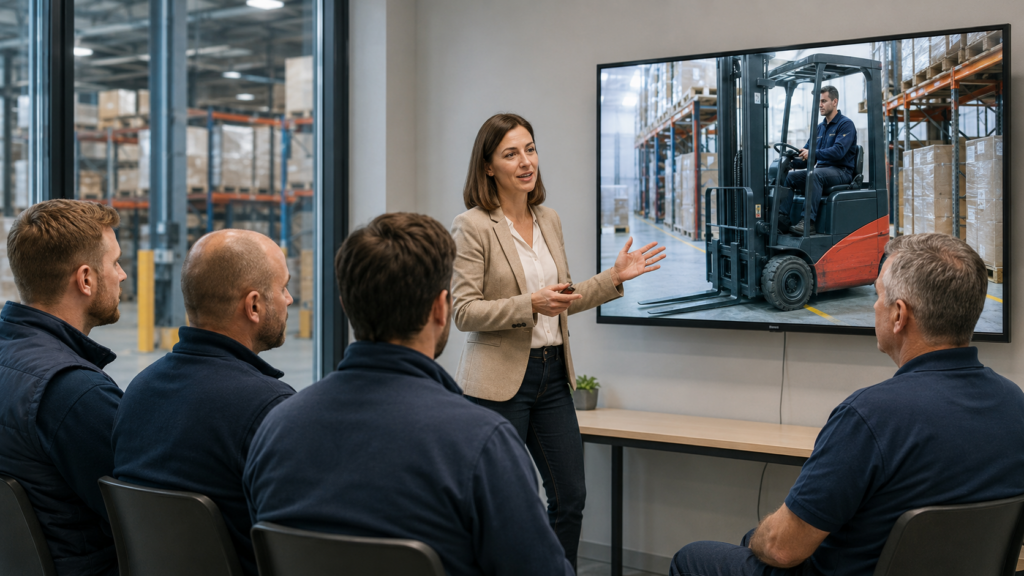
| The key point for operations The best candidate for a critical position does not always have to come from outside. Sometimes they are already working in the company. They only need a clear selection framework, short retraining, quality onboarding and the trust that their growth has real value for the company. |
Who makes sense to select?
When retraining someone for the role of warehouse worker or forklift driver, it is not enough to look only at who is interested. It is important to select employees who have the real potential to handle the new position safely, reliably and in the long term.
| Work behaviour | Requirements for warehouse / forklift work |
| • follows OHS and work procedures | • has good orientation in production |
| • works without repeated mistakes | • understands the flow of material and process continuity |
| • respects management, rules and work discipline | • has spatial orientation and can manoeuvre safely |
| • handles routine as well as operational pressure | • has basic skills with digital tools |
| • is motivated to grow and take on greater responsibility | • is medically fit to work with a forklift |
This type of selection is essential. Retraining should not be a random reward or an emergency solution. It should be part of managed workforce development.
How retraining can work in practice
With a well-set process, retraining can be relatively fast. In many cases, it makes sense to work with a time frame of 2 to 4 weeks, depending on the type of operation, the complexity of the work, the employee’s experience and the company’s internal requirements.
- Selection of suitable employees
- The company identifies operators or employees from other positions who have long shown reliability, responsibility and the desire to move forward. It is important to involve foremen, team leaders and HR, because direct supervisors know people’s everyday work behaviour best.
- The company identifies operators or employees from other positions who have long shown reliability, responsibility and the desire to move forward. It is important to involve foremen, team leaders and HR, because direct supervisors know people’s everyday work behaviour best.
- Verification of prerequisites
- Before the actual transfer, it is necessary to assess medical fitness, safety risks, the ability to work in a warehouse, spatial orientation and basic technical or digital habits.
- Before the actual transfer, it is necessary to assess medical fitness, safety risks, the ability to work in a warehouse, spatial orientation and basic technical or digital habits.
- Forklift training and examination
- The selected employee completes the required training, practical preparation and examination. The goal is not only to obtain certification, but to prepare the person for real situations in the specific operation.
- The selected employee completes the required training, practical preparation and examination. The goal is not only to obtain certification, but to prepare the person for real situations in the specific operation.
- Practical onboarding directly in the warehouse
- After training, work under supervision follows. The employee gradually becomes familiar with receiving and dispatching materials, internal movement of goods, warehouse logic, forklift handling in real operations, working with a scanner and the warehouse system.
- After training, work under supervision follows. The employee gradually becomes familiar with receiving and dispatching materials, internal movement of goods, warehouse logic, forklift handling in real operations, working with a scanner and the warehouse system.
- Gradual assumption of responsibility
- The new warehouse worker does not immediately start at full performance. First, they carry out simpler tasks, then move on to more independent work. At the same time, the company monitors quality, safety, accuracy of records and adaptation within the team.
Why internal retraining is beneficial
- Faster adaptation
- The employee already knows the environment, company rules and the rhythm of operations. They do not need to get used to the company itself, only to the new role.
- Lower costs than external recruitment
- The company does not have to invest as much time in searching, advertising, interviews and repeated training of candidates who leave after a short time.
- Higher stability and loyalty
- An employee who gets the opportunity to grow has a stronger reason to stay. They see that the company is counting on them and giving them a chance.
- Operational effect
- The critical position is filled faster and the company reduces the risk of lacking a person in a role on which the smooth running of production, supply or dispatch depends.
Retraining, however, cannot work without a system
For internal transfers to make sense, a company needs more than just a good idea. It needs a simple system for working with employee potential.
The foundation is an internal skills map. The company should know which people have the potential to handle another position, who has technical thinking, who is reliable, who can handle pressure, who wants to grow and who already naturally helps others today.
Cooperation between HR and operations is also important. HR can set up the process, but employees’ direct supervisors see their potential best. For retraining to be successful, candidate selection must be a joint decision.
The company must also keep in mind that moving a person from one position creates a need to replace them elsewhere. That is also why retraining should be part of broader workforce planning, not an isolated last-minute intervention.
A practical framework for the company
| Question for the company | What to monitor | Output |
| Where do we have critical positions? | staffing, turnover, absences, risk of disruption | list of priority roles |
| Who has internal potential? | work habits, responsibility, technical thinking | employee shortlist |
| What skills are missing? | certifications, practical habits, system work | retraining plan |
| How do we measure success? | adaptation, quality, safety, stability | evaluation after 30/60/90 days |
Candidates become an internal project
A shortage of candidates is not just a recruitment problem. It is a problem of planning, qualification and the ability to work with the people the company already has.
Companies that keep waiting only for the ideal candidate from outside will increasingly run into the limits of the market. Companies that can develop part of the people they need internally will gain greater flexibility, stability and control over their own operations.
Retraining an operator into a warehouse worker with forklift certification is a practical example. However, the same principle can also be applied to other positions – in quality, maintenance, logistics, production administration or technical support roles.
Conclusion: a company’s own workforce is a resource that companies often underestimate
Retraining is no longer an extra benefit. In an environment of candidate shortages, it is becoming a practical tool for keeping production running, reducing dependence on the external market and strengthening employee loyalty.
The best candidate for a critical position does not always have to come from outside. Sometimes they are already working in the company. They only need to be given an opportunity, a clear plan, quality onboarding and the trust that their growth has real value for the company.
.