


In July and August, emails often slow down in companies, calendars become emptier, and some people disappear on holiday. But for HR, this does not mean peace and quiet. Summer shows very precisely whether a company merely records holidays or truly manages capacity. In July, something unusual happens in many companies. Emails slow down, calendars thin out, some people disappear on holiday, and at first glance the atmosphere feels more relaxed. In offices, people talk about the weather more often, corridors are quieter, and in operations one important word starts to come up: shutdown. It might seem that HR finally gets a moment of calm. But summer often reveals how well a company really manages its people. Not on paper. Not in a presentation for management. But in practice. On shifts, in attendance, in returns after holidays, and in whether production starts back up according to plan after a company-wide holiday shutdown. Summer is not a slow season. For HR, it is more of a stress test. And the good news is that tests are not meant to sink a company. They are meant to show where the system has weak points.
The biggest misconception: approved holiday does not mean managed capacity
Having holidays approved in the system is a foundation. But it is not the same as having operations under control. A company may know exactly who will be away from work in July and August. It may have completed spreadsheets, approved requests, informed managers, and a clear calendar. Yet it can still be surprised to find that, in a specific week, it is missing people in critical positions. The problem with summer is usually not that HR does not know who is on holiday. The problem is that the company sometimes mistakes absence records for capacity planning.
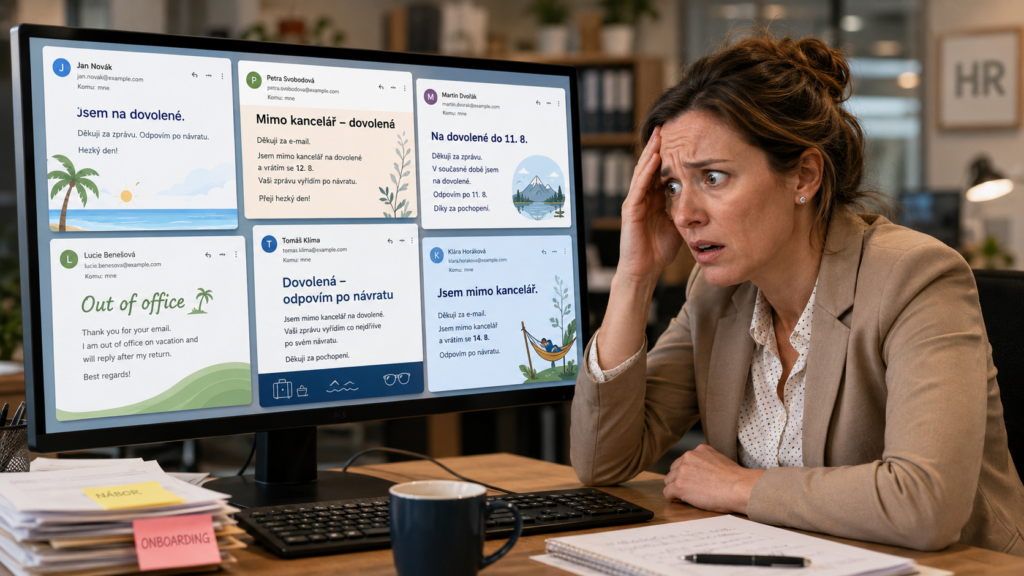
| Records say: these people will be away. Capacity planning says: even though they will be away, operations will keep running. And it is this second sentence that determines whether a company gets through the summer without unnecessary stress. |
Holidays are not the problem. The problem is when a company has no backup capacity
Holiday itself is, of course, not a risk. People need to rest, and a well-managed company accounts for that. Risk only arises when several factors come together at once. The more experienced part of the team goes on holiday. Several people fall ill. A temporary worker who was supposed to start decides to take another job. An agency worker needs to deal with a personal situation. The shift supervisor is away too. And on top of that comes the requirement to maintain output, because orders do not ask whether it is thirty degrees outside. This is not an extreme scenario. This is a normal summer in many manufacturing companies. The difference between a prepared and an unprepared company is not that disruptions happen to one and not the other. Disruptions happen to everyone. The difference lies in how quickly the company identifies the problem, who deals with it, and whether it has a backup option ready.
A company-wide holiday shutdown is not just about switching off operations. It is a test of the restart
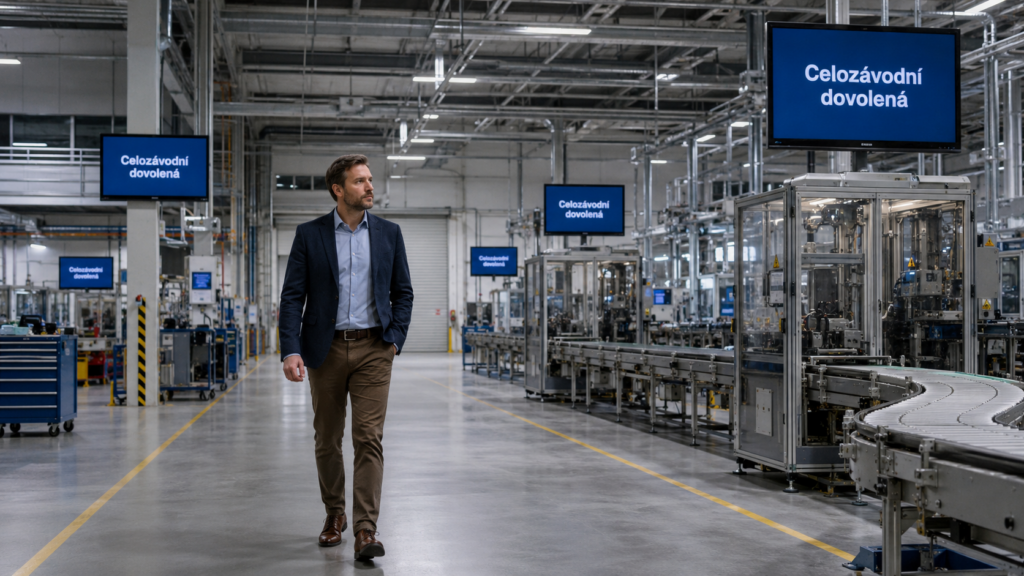
In many manufacturing companies, the company-wide holiday shutdown falls in the last week of July and the first week of August. Operations slow down or stop, people leave, part of management gets some rest, and the company catches its breath for a while. From an HR perspective, however, the most important part is not the “switch-off” itself. The restart matters more. The first day after a company-wide holiday shutdown is often a very accurate indicator of how the company communicates with its people. Who knows when they should come in? Who has a confirmed shift? Who is returning from abroad? Who is available? Who is not responding? Who is missing, and why? If these questions only start being addressed on the morning of the return, the company is already losing time. That is why well-prepared HR does not wait for the first Monday in August. It works with the return before people even leave for holiday. It confirms shifts. It reminds people of dates. It communicates through shift supervisors, coordinators, and the agency. It checks critical positions. It prepares backup capacity. This may not sound as attractive as a company strategy for the next quarter. But in operational reality, this preparation can decide whether production restarts smoothly or chaotically.
People who do not return after holiday usually did not send a warning a week in advance
One of the most sensitive summer topics comes right after the company-wide holiday shutdown. Some people may simply not return. Someone is delayed. Someone extends their stay at home. Someone had already been thinking about changing jobs for some time, and the holiday was just a natural turning point. For foreign workers, travel complications, family reasons, documents, or returning from their country of origin may play a role. For temporary workers, it may be a lower level of commitment to the employer and more alternatives. It is tempting to see this as an individual failure. But for HR, it is more useful to ask a different question: could it have been at least partially prevented? Sometimes not. But often yes. For example, through better communication before people leave for holiday. A clear confirmation of the return date. Personal contact with higher-risk groups of workers. Timely preparation of replacements. Involving coordinators. Or simply checking that everyone really understands when and where they are supposed to return. In good HR, a detail is not a minor thing. A detail is problem prevention.
Summer disruptions show whether a company is built on a system or on improvisation
Every company can improvise. The question is how often it has to. If summer operations only hold together thanks to the willingness of a few people to work overtime, quick phone calls, last-minute shift swaps, and the personal commitment of shift supervisors, it may work in the short term. From the outside, nothing dramatic may happen. Production is managed, orders are shipped, and management receives the information that the situation has been resolved. But from an HR perspective, this is a warning sign. A system that works only thanks to improvisation is not stable. It is only temporarily lucky. Summer shows very clearly where the company does not have enough backup capacity. Which positions are too dependent on specific people. Where substitutability is missing. Where communication is slow. Where agency workers are not treated as part of the team, but only as an item in the schedule. Where attendance and capacity data are used only retrospectively instead of helping to predict risks. This is not criticism. It is an opportunity. A company that names these areas in the summer has a chance to be much stronger in the autumn.
Flexibility is not an emergency call. It is a prepared model
The word flexibility is used often in HR. Sometimes too often. In practice, however, it is not about a company being able to call half the market on a Friday afternoon and look for people for Monday. That is not flexibility. That is crisis mode. True flexibility means that the company knows where its risk areas are. It has thought through in advance which positions can be covered by temporary workers, where it needs more experienced agency workers, where longer preparation is necessary, and where it cannot operate without a stable team. It has a partner that understands its operations. And it has enough time to react before the problem hits the shift. This is also crucial for international recruitment. Companies often start thinking about workers from abroad only when they are already short of people. But stable international recruitment is not a solution for next week. It is a process that requires selection, preparation, documentation, relocation, adaptation, and ongoing care.
| If you want to have people in September, you should not start thinking in September. |
Summer should not end with the company simply breathing a sigh of relief
If a company gets through July and August, it is natural to say: good, we have made it through. But this is exactly where the greatest value often disappears.
After the summer, HR, production, and management should sit down together and look at several simple but important questions:
- Where did we have the biggest problem with staffing?
- Which shifts were the most sensitive?
- Where were we dependent on improvisation?
- Which people or positions were irreplaceable?
- Where did communication work, and where did it not?
- How much time did we spend dealing with disruptions that could have been prevented?
- What do we need to change so that next summer is not the same?
This is not an exercise for a spreadsheet. It is the basis for better workforce planning. Because summer does not repeat itself in exactly the same way every year. But the types of problems do.

A slow season? Maybe. But not for companies that want stable operations
In the media, summer is often called the slow season. In HR, perhaps it should be called the season of truth. Not because it has to be dramatic. But because it reveals things that can easily be overlooked during the year: weak substitutability, insufficient communication, missing backup capacity, recruitment that starts too late, or underestimated work with agency and foreign workers. A well-managed company is not afraid of summer. But it also does not pretend that nothing can happen. It prepares, communicates, works with data, and has a scenario for situations that may not be pleasant but are predictable. And that is precisely the difference between HR that merely manages holidays and HR that truly manages capacity.