


Every year, companies say they are short of people. They lack technicians, administrative workers, planners, logistics specialists, salespeople and specialists. At the same time, however, thousands of young people enter the labour market and often encounter the same response: “You do not have enough experience.”
The period of final exams, state exams and school graduations raises an important question every year. Where are young people supposed to gain their first work experience if companies are not willing to give it to them? For many graduates, entering the labour market is a harsh confrontation with reality. After years of study, part-time jobs and preparation, they come with the expectation that they will start building their professional path. Instead, they often find that even positions labelled as junior require two, three or even more years of experience.
| The key question for companies is not why graduates have no experience. The question is how many real opportunities companies create for them to gain it? |
From the candidate’s perspective, this is frustrating. From the labour market perspective, it is a missed opportunity. Every experienced professional was once a graduate. Every manager was once a junior. Every person who today leads a team, manages processes or sets strategy once sat at their first interview without an extensive CV. They had school, a few part-time jobs, basic experience and a willingness to learn.
Experience is not created at school. It is created in companies.
School can give a person a theoretical foundation, a way of thinking, discipline and the ability to work with information. However, it cannot replace a real work environment, company culture, team communication, responsibility for results or everyday handling of practical situations. All of this is created only at work. That is why it is not realistic to expect a graduate to arrive ready as an experienced specialist. A junior needs time, guidance, feedback and room for mistakes. The first months can be more demanding for both the junior and the company. They require patience, mentoring and clearly set expectations. But this very investment can pay companies back more than they often realize.
“Talent is often not missing. What is missing is space.”
Graduates bring energy, curiosity, willingness to learn and a fresh perspective into an organization. They do not come with deeply rooted habits from other companies. They are open to the way things work at a specific employer. They can adapt quickly if they receive a clear assignment, support and a meaningful perspective.
A junior as an investment, not a compromise.
Many companies today talk about a lack of talent. But talent does not always have to be a ready-made person with five years of experience who can immediately take over an agenda and perform from day one without the need for guidance. Talent is often a person at the beginning of their career who does not yet have all the answers, but has the desire to work, ask questions, improve and grow.
This is exactly where the difference lies between a short-term and long-term view of recruitment. A company that looks only for ready-made candidates competes with others for the same group of people.
A company that can work with juniors creates its own source of future specialists. What matters is not only what they know on the first day.
| Where graduates can find their place: • administration • logistics and purchasing • customer support • HR and recruitment | Where juniors can be trained within six to twelve months: • quality • technical support • production planning • sales support |
Juniors need a system, not just a chance.
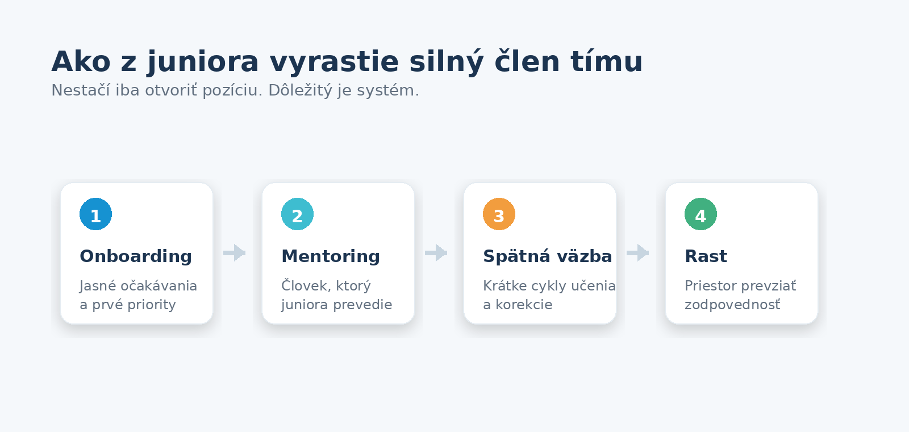
Hiring a graduate does not mean simply opening a position and waiting for them to somehow adapt. If involving juniors is to be successful, the company needs a system. Clear onboarding, clearly defined tasks, regular feedback and a person – a mentor who guides the junior through the first months – are important. A young employee does not have to immediately understand company processes, priorities or what is expected of them in different situations. But if they receive guidance, they can grow very quickly.
From the company’s perspective, this is a decision about whether it wants only to fill vacancies or build people for the future. The first path solves a problem today. The second creates stability for the years ahead. Companies that can work with graduates are not only developing employees. They are developing future specialists, experts, managers and leaders.
At the same time, they strengthen their own employer brand, because young people remember very well who gave them their first real opportunity.
The first chance can decide an entire career.
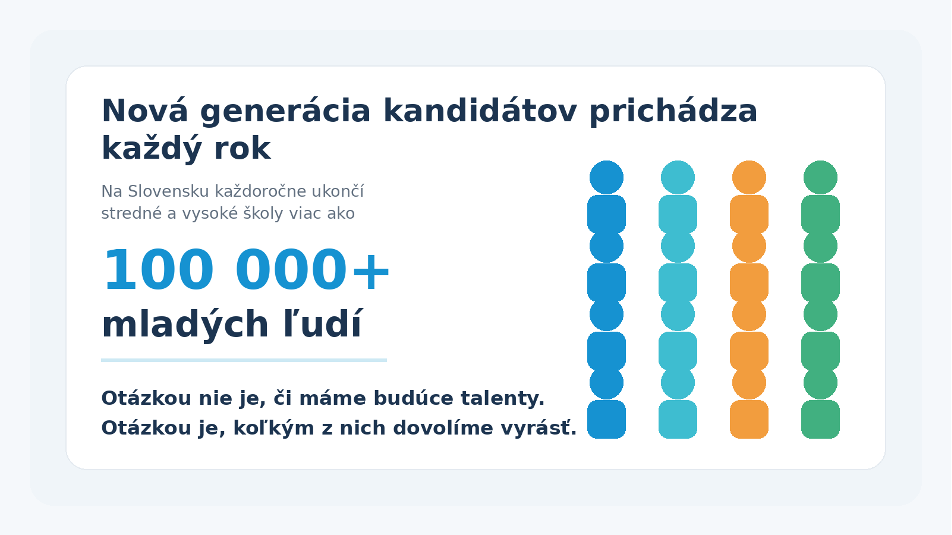
For a graduate, the first job is more than just an item on a CV. It is an experience that shapes their relationship with work, responsibility, the team and their own abilities. If a young person is given trust, support and fair expectations, they often repay the company with loyalty, energy and a willingness to grow together with it. But if they repeatedly hear only that they do not yet have enough experience, the labour market stops being a space of opportunity for them and becomes a closed circle. In Slovakia, more than 100,000 young people complete secondary schools and universities every year. This is not a marginal group. It is a significant source of future talent that deserves more attention.
At a time when companies are dealing with candidate shortages, an ageing workforce and pressure on productivity, graduates should not stand on the margins of interest. On the contrary. They should be a natural part of the personnel strategy.
| Because the question is not whether we have future talent on the market. The question is how many of them we allow to grow. |